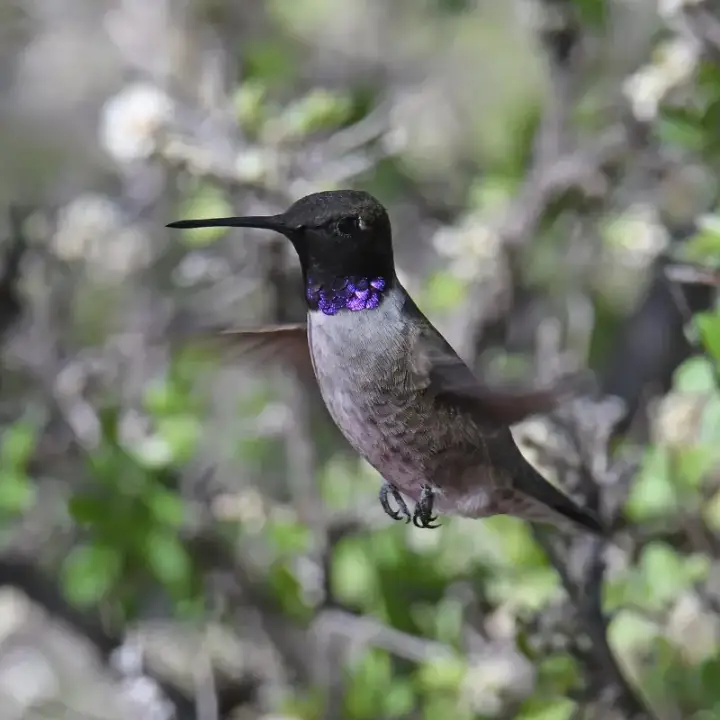
Black-chinned Hummingbird
Archilochus alexandri · Hummingbirds
Banding codeBCHU
Keys to identifying it
1Size & shape
About 3.5 in long.
2Color pattern
- Male: black chin with a thin violet band below
- Green above, whitish below
- Long straight bill; pumps its tail while hovering
3Habitat & season
Riparian canyons, yards with feeders and flowers
In northern Utah: summer.
Seen most often in July and August.
Share of the region’s research-grade iNaturalist bird observations each month, scaled to this bird’s peak. Highlighted bars are its peak months.
4Voice
Soft 'tchew' calls; the male's wings make a dull whine.
“tchew · a low wing hum”
iNat 153257015 by Bob Nieman · Rattlesnake Springs, Eddy County, NM, USA · CC BY
Know it
- The male's violet throat band shows only when light hits it just right.
- Weighs about 3 grams — roughly the same as a penny.
- Binds its nest with spider silk so it stretches as the chicks grow.
Often confused with
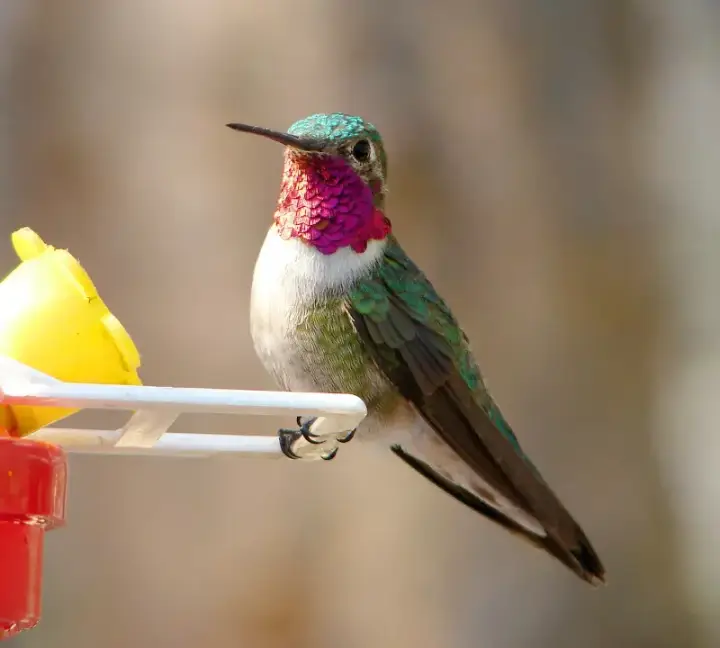 Broad-tailed Hummingbird
- Anna's Hummingbird
- Ruby-throated Hummingbird
From iNaturalist identification data for northern Utah.
From Wikipedia
The black-chinned hummingbird is a hummingbird occupying a broad range of habitats from deserts to mountain forests and urban areas in the western United States, southern British Columbia, and Mexico. It is migratory, wintering as far south as Mexico. In sunlight, an iridescent purple gorget forming a ring below the black chin feathers is a male characteristic. When in flight and hovering, its wings make a low-pitched humming sound.
Wikipedia · CC BY-SA 4.0