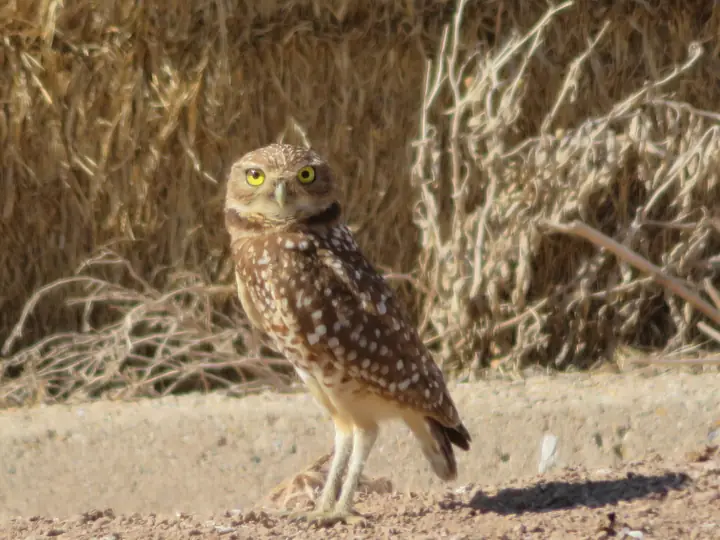
Burrowing Owl
Athene cunicularia · Typical Owls
Banding codeBUOW
Keys to identifying it
1Size & shape
About 9.5 in long.
2Color pattern
- Small owl on long legs
- Bright yellow eyes
- Spotted brown; often stands at a burrow entrance
3Habitat & season
Open grasslands and desert with burrows
In northern Utah: summer.
Seen most often in June, July and August.
Share of the region’s research-grade iNaturalist bird observations each month, scaled to this bird’s peak. Highlighted bars are its peak months.
4Voice
A soft, dove-like 'coo-coooo'.
“coo-coooo”
iNat 172698901 by Xochitl Zambrano · 21355 Mexicali, B.C., México · CC BY
Know it
- Nests underground, often in old prairie dog or ground squirrel burrows.
- Young owls in the burrow make a hiss that sounds like a rattlesnake.
- Scatters animal dung around its burrow, which attracts dung beetles to eat.
- Active in daylight as well as at night.
Often confused with
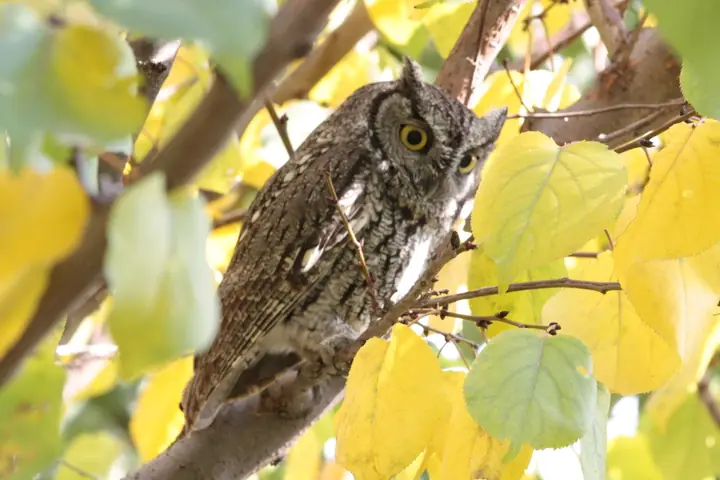 Western Screech-Owl
From iNaturalist identification data for northern Utah.
From Wikipedia
The burrowing owl is a small, long-legged, primarily terrestrial—though not flightless—species of owl native to the open landscapes of North and South America. They are typically found in grasslands, rangelands, agricultural areas, deserts, or any other open, dry area with low vegetation. They nest and roost in burrows, and, despite their common name, do not often construct these dwellings themselves, rather repurposing disused burrows or tunnels previously excavated and inhabited by other species, such as American badgers, foxes, ground squirrels or prairie dogs, among others.
Wikipedia · CC BY-SA 4.0