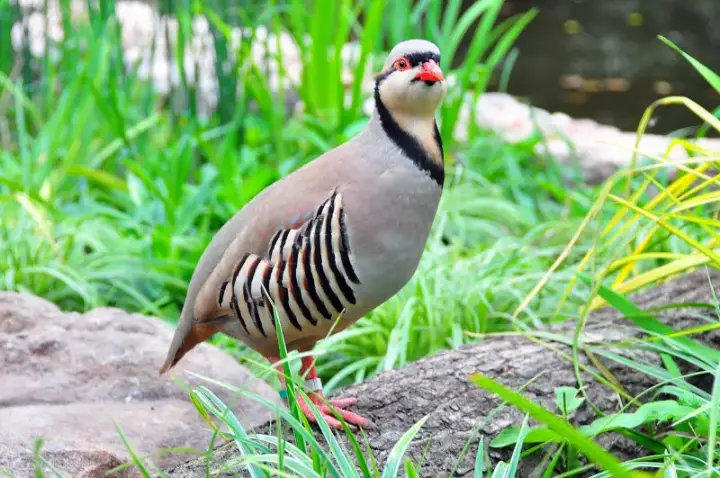
Chukar
Alectoris chukar · Pheasants, Grouse, and Allies
Banding codeCHUK
Keys to identifying it
1Size & shape
About 14 in long.
2Color pattern
- Gray-buff partridge
- Bold black necklace through the eye
- Red bill and legs; barred flanks
3Habitat & season
Steep, rocky, grassy slopes and canyons
In northern Utah: year-round.
Seen most often in February, March and October.
Share of the region’s research-grade iNaturalist bird observations each month, scaled to this bird’s peak. Highlighted bars are its peak months.
4Voice
A loud, accelerating series of clucks.
“chuck-chuck-chukar”
iNat 151416808 by River Ahlquist · Death Valley National Park, Inyo County, US-CA, US · CC BY
Know it
- Introduced from Asia as a game bird; it thrives on Utah's rocky slopes.
- Chicks run up steep slopes while flapping their wings for extra grip.
- Named for its call.
- The national bird of Pakistan.
Often confused with
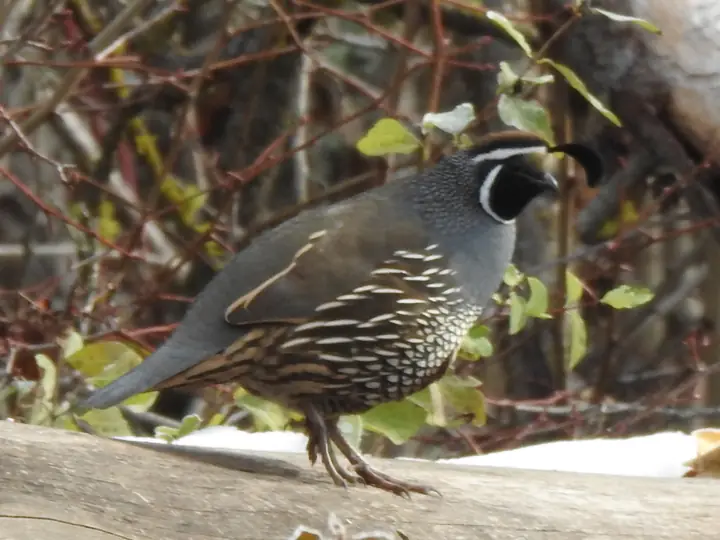 California Quail
- Gambel's Quail
- Dusky Grouse
From iNaturalist identification data for northern Utah.
From Wikipedia
The chukar partridge, or simply chukar, is a Palearctic upland gamebird in the pheasant family Phasianidae. It has been considered to form a superspecies complex along with the rock partridge, Philby's partridge and Przevalski's partridge and treated in the past as conspecific particularly with the first. This partridge has well-marked black and white bars on the flanks and a black band running from the forehead across the eye down the head to form a necklace that encloses a white throat. Native to Asia, the species has been introduced into many other places and feral populations have established themselves in parts of North America, Malta and New Zealand. This bird can be found in parts of Middle East and temperate Asia.
Wikipedia · CC BY-SA 4.0