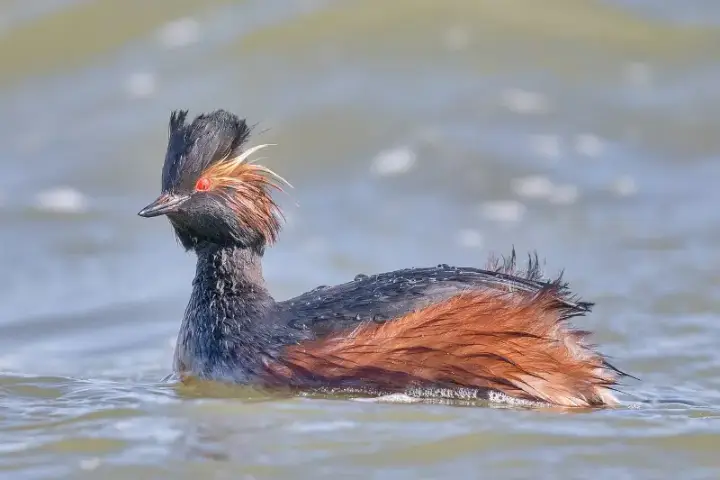
Eared Grebe
Podiceps nigricollis · Grebes
Banding codeEAGR
Keys to identifying it
1Size & shape
About 12.5 in long.
2Color pattern
- Breeding: black neck and golden fan of plumes behind a red eye
- Winter: gray and white with dusky cheeks
- Small, thin bill; fluffy rear end
3Habitat & season
Great Salt Lake and salty or marshy ponds
In northern Utah: spring to fall.
Seen most often in January, April, May, October and November.
Share of the region’s research-grade iNaturalist bird observations each month, scaled to this bird’s peak. Highlighted bars are its peak months.
4Voice
Mostly quiet; a rising whistle on breeding ponds.
“a soft, rising 'poo-eep'”
Warbly has no recording of this bird.
Know it
- Each fall, 1 to 2 million gather on the Great Salt Lake to fatten on brine shrimp.
- Can be flightless for 9 to 10 months of the year — longer than almost any other flying bird.
- Eats its own feathers, like all grebes.
- The most abundant grebe in the world.
Often confused with
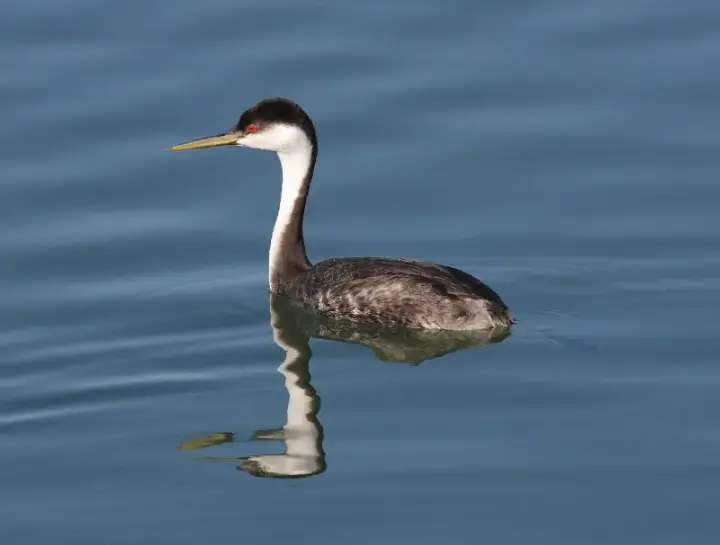 Western Grebe
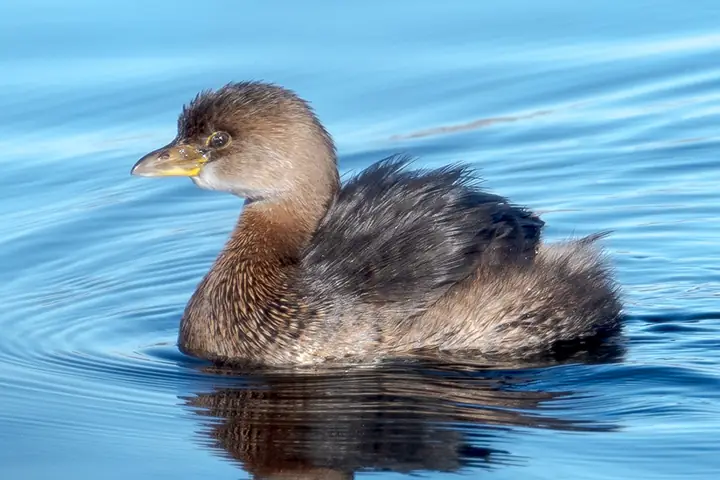 Pied-billed Grebe
- Horned Grebe
- Silvery Grebe
From iNaturalist identification data for northern Utah.
From Wikipedia
The black-necked grebe or eared grebe is a member of the grebe family of water birds. It was described in 1831 by Christian Ludwig Brehm. Its breeding plumage features distinctive ochre-coloured feathers which extend behind its eye and over its ear coverts. The rest of the upper parts, including the head, neck, and breast, are coloured black to blackish brown. The flanks are tawny rufous to maroon-chestnut, and the abdomen is white. In its non-breeding plumage, this bird has greyish-black upper parts, including the top of the head and a vertical stripe on the back of the neck. The flanks are also greyish-black. The rest of the body is a white or whitish colour. The juvenile has more brown in its darker areas. This species is present in parts of Africa, Eurasia, and the Americas.
Wikipedia · CC BY-SA 4.0