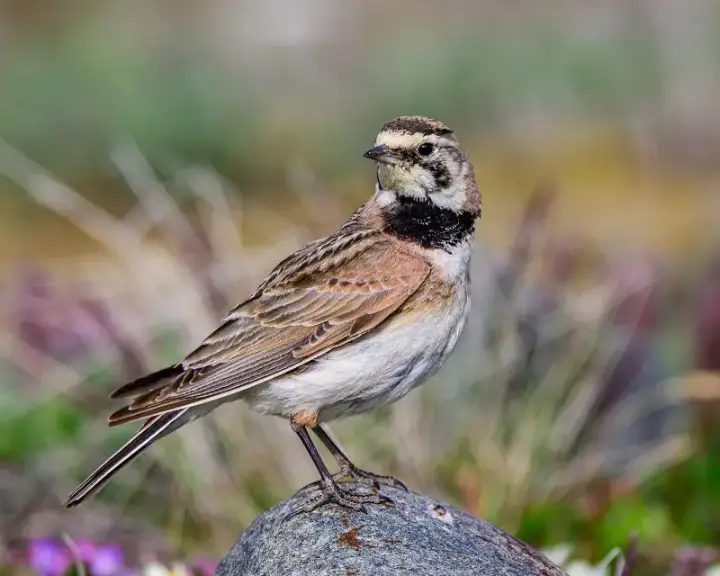
Horned Lark
Eremophila alpestris · Larks
Banding codeHOLA
Keys to identifying it
1Size & shape
About 7 in long.
2Color pattern
- Tiny black 'horns' (feather tufts)
- Black mask and chest band
- Yellow-white face
3Habitat & season
Barren fields, sagebrush flats, salt flats
In northern Utah: year-round.
Seen most often in February and May.
Share of the region’s research-grade iNaturalist bird observations each month, scaled to this bird’s peak. Highlighted bars are its peak months.
4Voice
A high, tinkling song often given in flight.
“tsee-titi, a tinkling jingle”
iNat 268989605 by Samantha Heller · Van Buren, AR 72956, USA · CC0
Know it
- North America's only native lark.
- Males sing high in the air, then plunge toward the ground.
- Prefers the barest ground it can find — even plowed fields and salt flats.
- Its 'horns' are feather tufts it can raise or flatten.
Often confused with
- American Pipit
From iNaturalist identification data for northern Utah.
From Wikipedia
The horned lark or shore lark is a species of lark in the family Alaudidae found across the northern hemisphere. It is known as "horned lark" in North America for distinctive feathers on the heads of the male birds in summer, and as "shore lark" in Europe because it can be found on shorelines in the winter.
Wikipedia · CC BY-SA 4.0