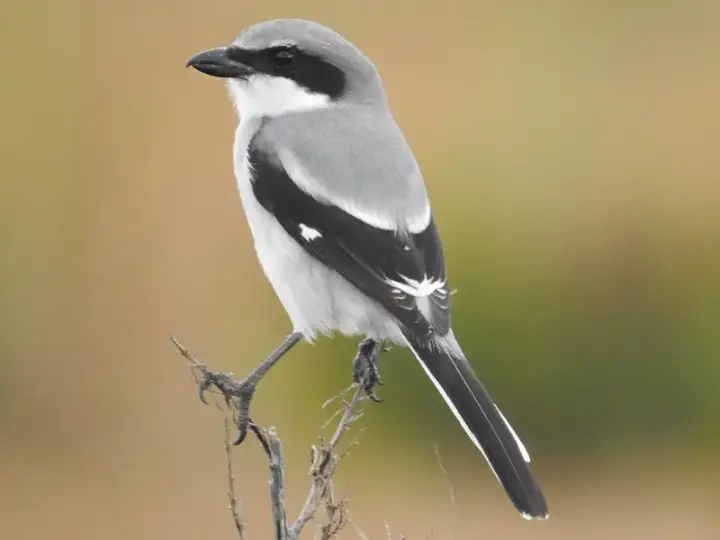
Loggerhead Shrike
Lanius ludovicianus · Shrikes
Banding codeLOSH
Keys to identifying it
1Size & shape
About 9 in long.
2Color pattern
- Gray with a black mask that meets above the bill
- Hooked bill
- Black wings with a white patch
3Habitat & season
Open country with fences, shrubs and wires
In northern Utah: year-round.
Seen most often in August and November.
Share of the region’s research-grade iNaturalist bird observations each month, scaled to this bird’s peak. Highlighted bars are its peak months.
4Voice
Harsh, squeaky, repeated phrases.
“a creaky 'queedle-queedle'”
iNat 297584615 by Reanne ("Bean") Dunn · Pompano Beach, FL 33064, USA · CC BY
Know it
- A songbird that hunts like a raptor and impales prey on thorns or barbed wire.
- Can impale toxic grasshoppers and wait days for the toxins to break down before eating them.
- Its black mask meets above its hooked bill.
- Has declined sharply across North America.
Often confused with
- Northern Shrike
- Olive-sided Flycatcher
From iNaturalist identification data for northern Utah.
From Wikipedia
The loggerhead shrike is a passerine bird in the family Laniidae. It is the only member of the shrike family endemic to North America; the related northern shrike occurs north of its range; however, it is also found in Siberia. It is nicknamed the butcherbird after its carnivorous tendencies, as it consumes prey such as insects, amphibians, lizards, small mammals and small birds, and some prey end up displayed and stored at a site, for example in a tree. Due to its small size and weak talons, this predatory bird relies on impaling its prey upon thorns or barbed wire for facilitated consumption. The numbers of loggerhead shrike have significantly decreased in recent years, especially in Midwestern, New England and Mid-Atlantic areas.
Wikipedia · CC BY-SA 4.0