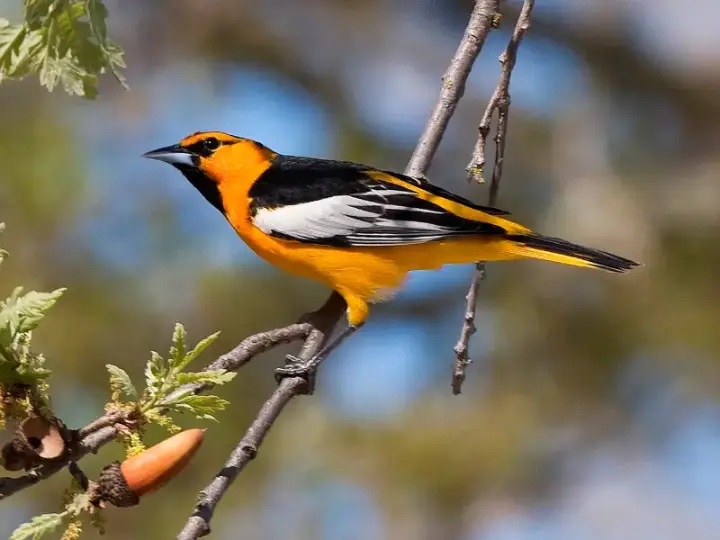
Bullock's Oriole
Icterus bullockii · New World Blackbirds and Orioles
Banding codeBUOR
Keys to identifying it
1Size & shape
About 7 in long.
2Color pattern
- Male: bright orange face and belly, black eyeline and throat
- Large white wing patch
- Female: gray body with yellow-orange head and tail
3Habitat & season
Cottonwoods along rivers, shade trees, orchards
In northern Utah: summer.
Seen most often in May and June.
Share of the region’s research-grade iNaturalist bird observations each month, scaled to this bird’s peak. Highlighted bars are its peak months.
4Voice
Rich whistles mixed with chatter; a dry rattle.
“a whistled jumble ending in a rattle”
iNat 272304596 by Chia/Ma'ayan (they/them) · Santa Rosa, CA 95401, USA · CC BY
Know it
- Weaves a hanging, pouch-like nest of plant fibers and horsehair.
- Was once lumped with the Baltimore Oriole as one species, the 'Northern Oriole.'
- Pierces ripe fruit to drink the juice and visits hummingbird feeders.
- The male has a black line through the eye and a big white wing patch.
Often confused with
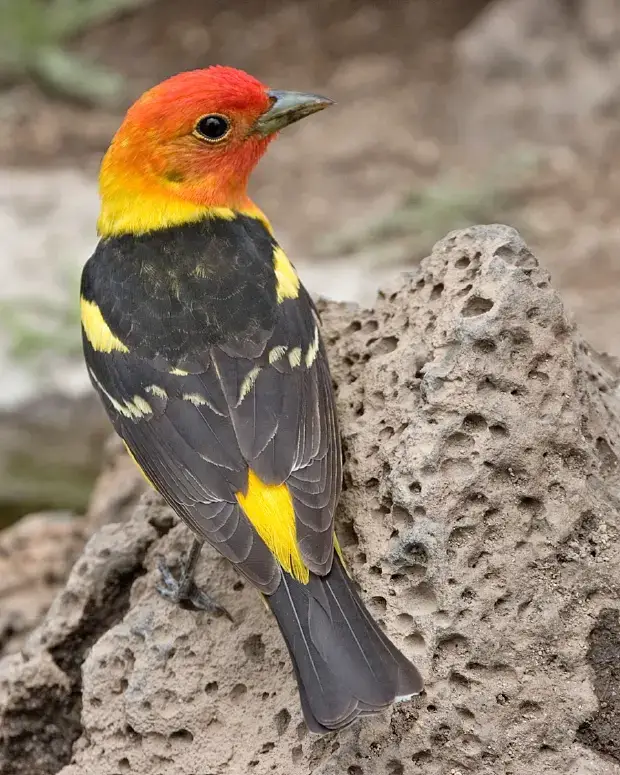 Western Tanager
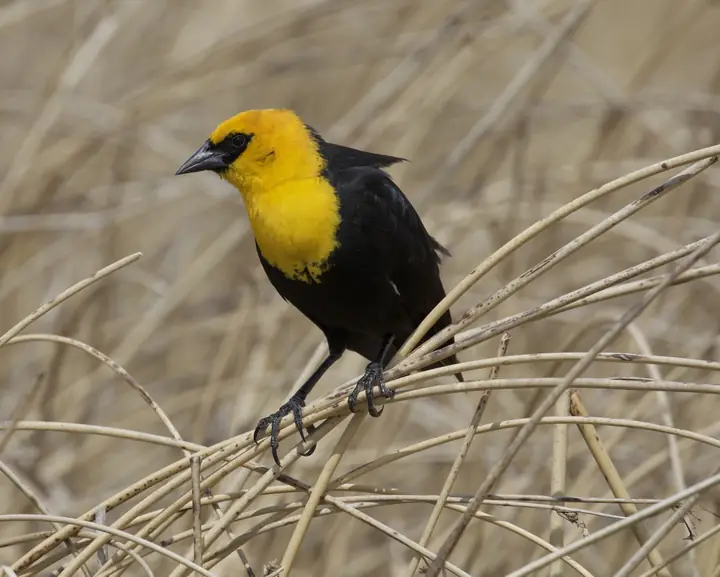 Yellow-headed Blackbird
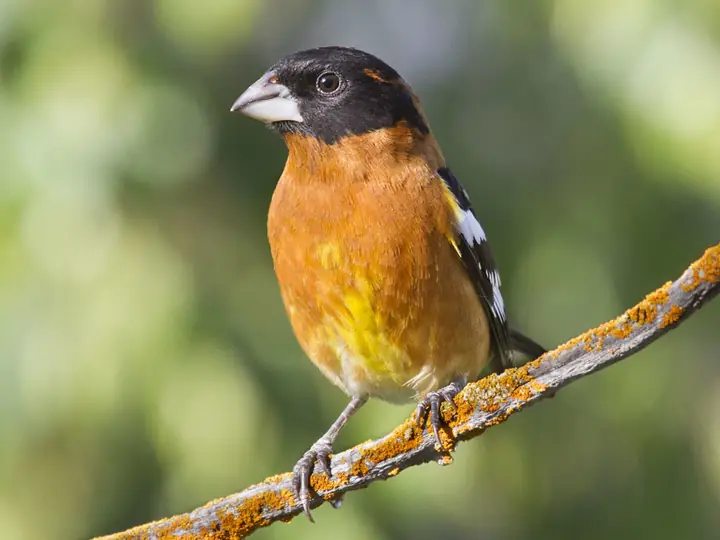 Black-headed Grosbeak
- Verdin
- Bullock's × Baltimore Oriole
From iNaturalist identification data for northern Utah.
From Wikipedia
Bullock's oriole is a small New World blackbird. At one time, this species and the Baltimore oriole were considered to be a single species, the northern oriole. This bird is named after William Bullock, an English amateur naturalist.
Wikipedia · CC BY-SA 4.0