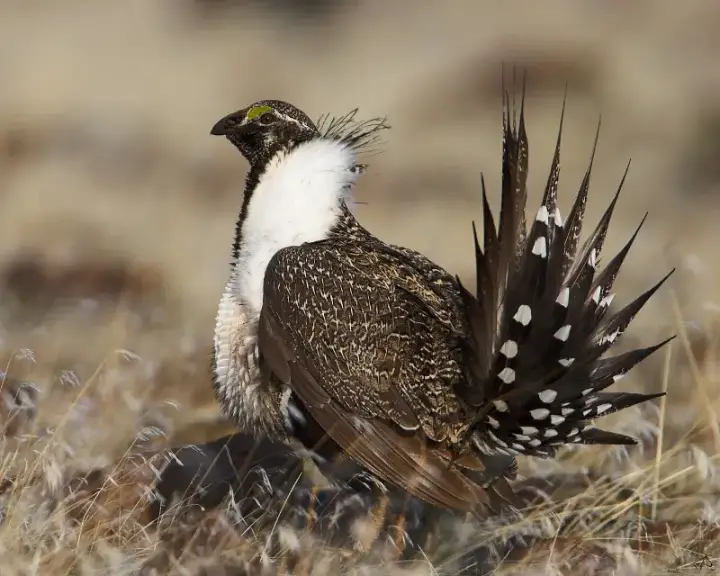
Greater Sage-Grouse
Centrocercus urophasianus · Pheasants, Grouse, and Allies
Banding codeGRSG
Keys to identifying it
1Size & shape
About 26 in long.
2Color pattern
- Large, mottled grouse
- Male: white ruff, black throat, spiky tail fan
- Inflates yellow air sacs when displaying
3Habitat & season
Large sagebrush landscapes
In northern Utah: year-round.
Seen most often in March.
Share of the region’s research-grade iNaturalist bird observations each month, scaled to this bird’s peak. Highlighted bars are its peak months.
4Voice
Popping, bubbling sounds from inflated air sacs on spring leks.
“swish-swish-whoop-POP”
iNat 267957602 by Jared Shorma · Jackson County, US-CO, US · CC BY
Know it
- Males gather at dawn on spring leks, inflating yellow air sacs that make popping sounds.
- In winter it eats almost nothing but sagebrush leaves.
- North America's largest grouse.
- Needs large, unbroken sagebrush landscapes to survive.
Often confused with
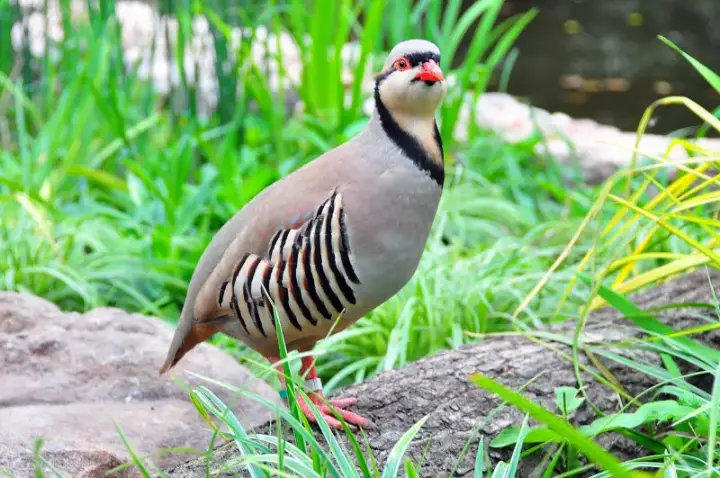 Chukar
- Dusky Grouse
- Ring-necked Pheasant
From iNaturalist identification data for northern Utah.
From Wikipedia
The greater sage-grouse, also known as the sagehen, is the largest grouse in North America. Its range is sagebrush country in the western United States and southern Alberta and Saskatchewan, Canada. It was known as simply the sage grouse until the Gunnison sage-grouse was recognized as a separate species in 2000. The Mono Basin population of sage grouse may also be distinct.
Wikipedia · CC BY-SA 4.0