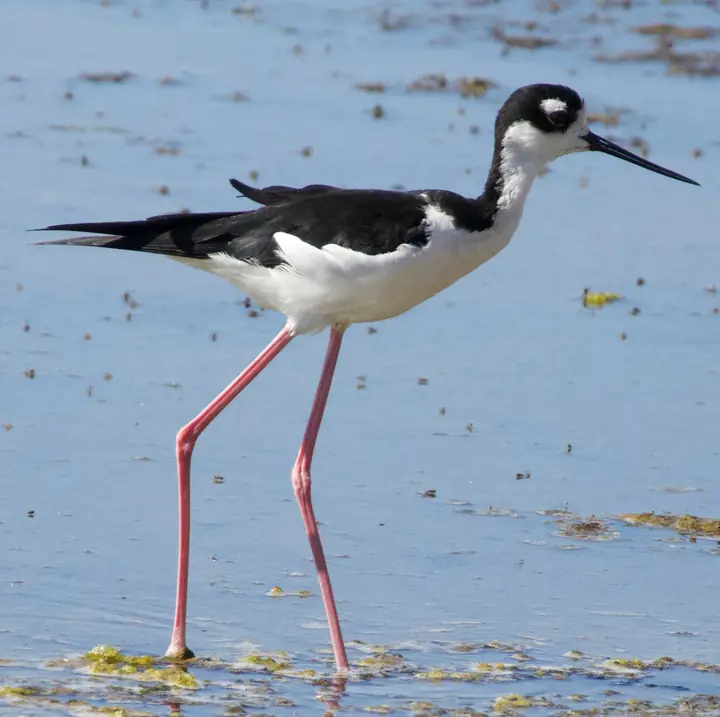
Black-necked Stilt
Himantopus mexicanus · Stilts and Avocets
Banding codeBNST
Keys to identifying it
1Size & shape
About 14 in long.
2Color pattern
- Very long bright pink-red legs
- Black above, white below
- Needle-thin black bill; white spot above the eye
3Habitat & season
Shallow wetlands, salt ponds, flooded fields
In northern Utah: summer.
Seen most often in April, May, June, July, August and September.
Share of the region’s research-grade iNaturalist bird observations each month, scaled to this bird’s peak. Highlighted bars are its peak months.
4Voice
Sharp yipping calls, like a small dog.
“kek-kek-kek (a yapping puppy)”
iNat 367341784 by Damien Wallace · Kalanianaole Hwy + Kuliouou Rd, Honolulu, HI 96821, USA · CC0
Know it
- Has some of the longest legs for its body size of any bird — second only to flamingos.
- Its yipping alarm sounds like a small dog barking.
- Wets its belly feathers to cool its eggs on hot days.
Often confused with
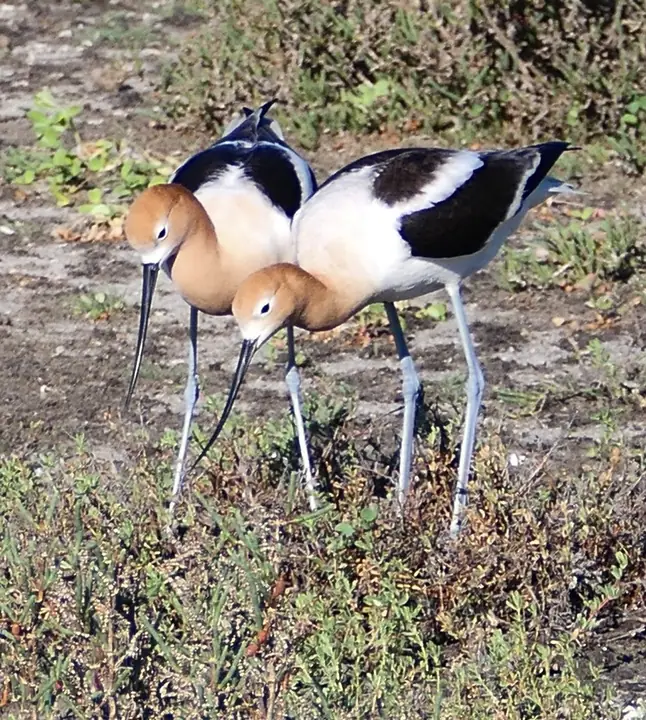 American Avocet
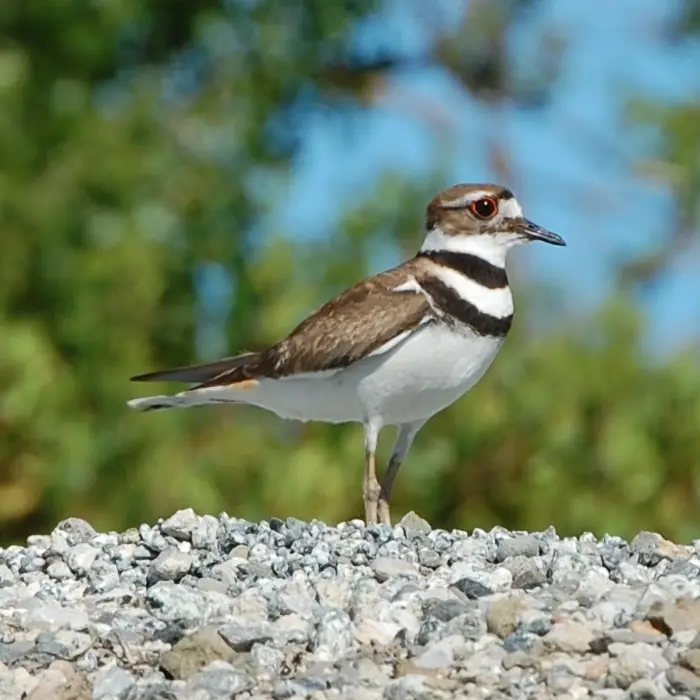 Killdeer
- Black-winged Stilt
- Black Stilt
From iNaturalist identification data for northern Utah.
From Wikipedia
The black-necked stilt, also called the pied stilt, is a locally abundant shorebird of North and South American wetlands and coastlines. It is found from the coastal areas of California through much of the interior western United States and along the Gulf of Mexico as far east as Florida, then south through Central America and the Caribbean to Brazil, Peru and the Galápagos Islands, with an isolated population, the Hawaiian stilt, in Hawaii. The northernmost populations, particularly those from inland, are migratory, wintering from the extreme south of the United States to southern Mexico, rarely as far south as Costa Rica; on the Baja California peninsula it is only found regularly in winter. Some authorities, including the IUCN, treat it as a synonym of Himantopus himantopus.
Wikipedia · CC BY-SA 4.0