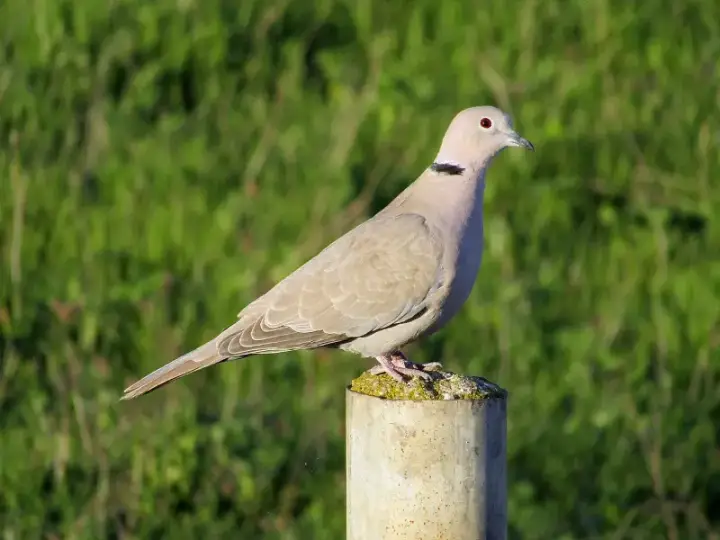
Eurasian Collared-Dove
Streptopelia decaocto · Pigeons and Doves
Banding codeEUCD
Keys to identifying it
1Size & shape
About 12 in long.
2Color pattern
- Pale sandy gray, chunky
- Narrow black half-collar on the back of the neck
- Square tail with broad white tips
3Habitat & season
Towns, farms, grain elevators
In northern Utah: year-round.
Seen most often in July, August, September, October, December, January, February, March and April.
Share of the region’s research-grade iNaturalist bird observations each month, scaled to this bird’s peak. Highlighted bars are its peak months.
4Voice
Three-part cooing repeated over and over; a harsh, nasal call in flight.
“koo-KOO-kook”
iNat 42258743 by Fyn Kynd · Grand County, UT, USA · CC BY-SA
Know it
- Pet-shop doves that escaped or were released in the Bahamas in the 1970s started a spread across North America, including Utah.
- Named for the thin black collar on the nape of its neck.
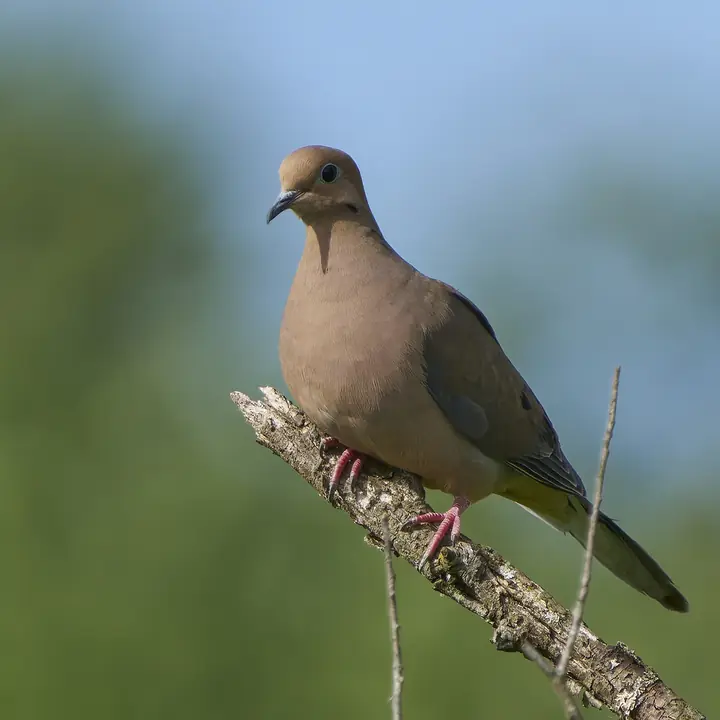
- Larger and paler than a Mourning Dove, with a square — not pointed — tail.
Often confused with
 Mourning Dove
 Rock Pigeon
 Cooper's Hawk
- African Collared-Dove
- Cape Turtle Dove
From iNaturalist identification data for northern Utah.
From Wikipedia
The Eurasian collared dove, often called the collared dove, is a dove species from the genus Streptopelia. It is grey-buff to pinkish-grey, and has a black half-collar edged with white on its nape, alluding to the name. It is native to Europe, Asia, and North Africa. It has also been introduced to Japan, North and Central America, and select Caribbean islands.
Wikipedia · CC BY-SA 4.0