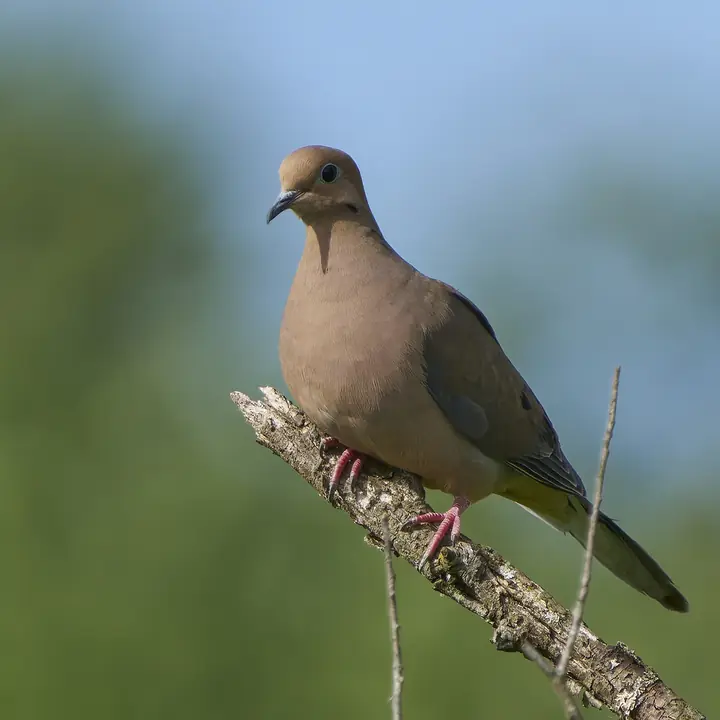
Mourning Dove
Zenaida macroura · Pigeons and Doves
Banding codeMODO
Keys to identifying it
1Size & shape
About 12 in long.
2Color pattern
- Slender, soft tan-gray body
- Long pointed tail with white edges
- Black spots on the wings
3Habitat & season
Farms, towns, open country
In northern Utah: year-round.
Seen most often in April, May, June, July, August and December.
Share of the region’s research-grade iNaturalist bird observations each month, scaled to this bird’s peak. Highlighted bars are its peak months.
4Voice
Low, mournful cooing; wings make a sharp whistle on takeoff.
“coo-OOO-oo, oo, oo”
iNat 375883335 by Mike Tilley · Lake Arthur, LA 70549, USA · CC BY
Know it
- Its wings make a whistling twitter when it bursts into flight.
- Both parents feed their young 'crop milk,' a protein-rich secretion.
- Can raise several broods in a single year when the weather stays warm.
- Often mistaken for an owl because of its soft, hooting song.
Often confused with
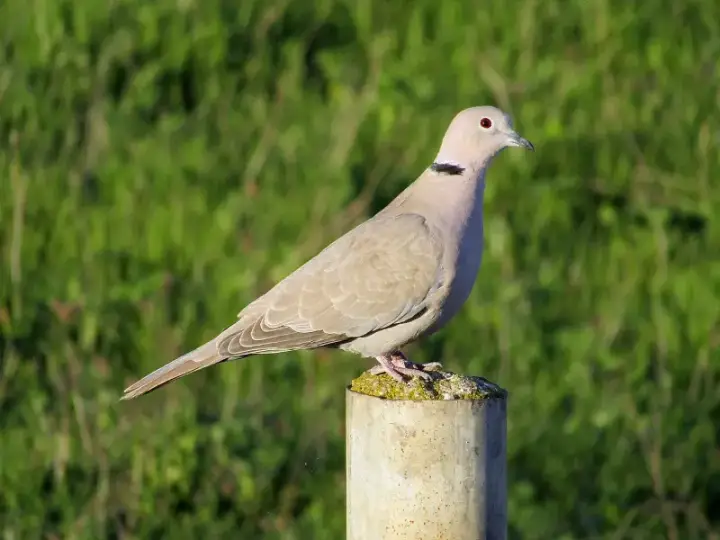 Eurasian Collared-Dove
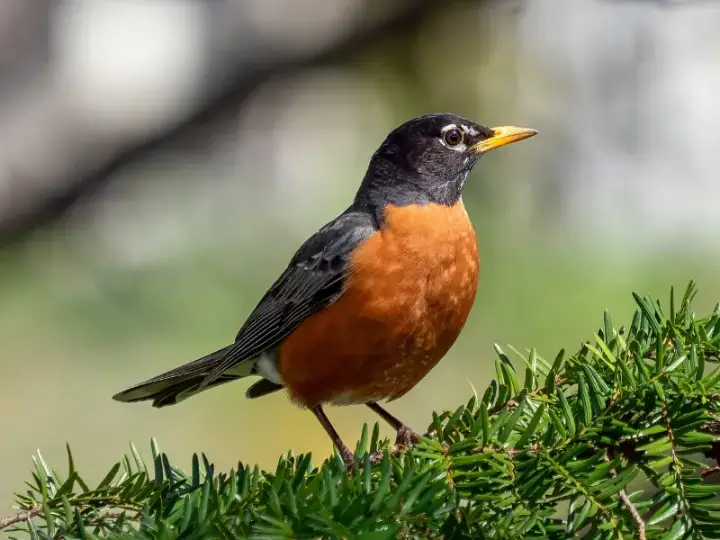 American Robin
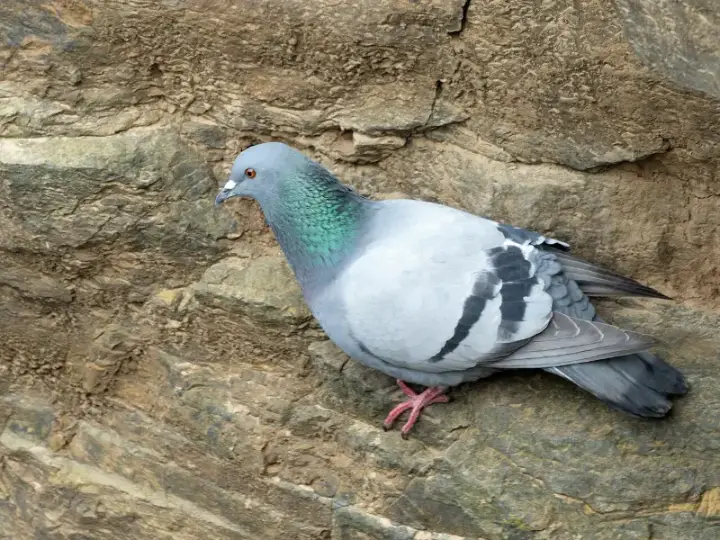 Rock Pigeon
- White-winged Dove
From iNaturalist identification data for northern Utah.
From Wikipedia
The mourning dove is a member of the dove family, Columbidae. The bird is also known as the American mourning dove, the rain dove, and colloquially as the turtle dove, and it was once known as the Carolina pigeon and Carolina turtledove. It is one of the most abundant and widespread North American birds and a popular gamebird, with more than 20 million birds shot annually in the U.S., both for sport and meat. Its ability to sustain its population under such pressure is due to its prolific breeding; in warm areas, one pair may raise up to six broods of two young each in a single year. The wings make an unusual whistling sound upon take-off and landing, a form of sonation. The bird is a strong flier, capable of speeds up to 88 km/h (55 mph).
Wikipedia · CC BY-SA 4.0